


There are seasons when a family disappears by inches.
Not all at once. Not in some great dramatic breaking.
Just slowly and quietly.
While everyone is still answering messages and making appointments, fixing cars and buying groceries and checking the news.
Just carrying on.
One day somebody asks for a family photo.
And you say, “Of course.”
Because surely there is one.
Somewhere in the digital archive we carry in our pockets, there is proof.
Five faces. One frame.
.
So I opened my phone and began to scroll.
And scroll.
And scroll.
Holidays. Receipts. Screenshots. Several accidental pictures of the inside of my bag. A sunset I must have thought was beautiful enough to save. Matt standing somewhere with coffee. One son here. Another there. Ella in uniform. A blurry picture of a shelter.
A dozen fragments of our life.
But not all five of us.
Not together.
The last picture I could find of our family was taken at Ella’s swearing in ceremony.
Almost two years ago.
I sat there staring at it longer than I meant to.
All of us standing in the same place. Shoulder to shoulder.
Unaware that the picture would become the last one for a while.
I guess that’s how grief works sometimes.
It doesn’t always arrive wearing black.
Sometimes it waits behind an ordinary request.
“Can you send a family photo?”
Of course.
Until you realize you don’t have one.
…
And the rest of the month unfolded in much the same way.
The car broke down so many times I lost count.
It was as if it finally decided it could no longer keep going on faith alone.
When it failed for the last time, my son was trying to take his brother back to the hospital for another X-ray because the foot that wasn’t broken suddenly looked very broken after all.
Because the car was so unreliable, we rented one.
The rental company assured us the bill would be around 1,000 shekels.
The final charge was more than 3,000.
I spent the bus ride arguing with customer service.
The phone hot against my ear as the city of Lod slid past my window while a stranger explained that the employee who gave me the original quote no longer worked there.
As if that settled it.
As if people can simply vanish and take the truth with them.
…
Later, my son called to tell me he was entering an armored driver’s course that could send him into Lebanon.
He said it in that practical tone young men use when they’re trying not to frighten their mothers.
Then, in the same conversation, he mentioned collecting the possessions of someone who had “fallen in battle.”
I remember standing very still while he spoke.
Then the owner of our facility sent a text asking if we would be renting for the fall semester.
I honestly don’t know.
That has become one of the truest sentences of my life.
I don’t know.
We keep waiting for ceasefires that seem to arrive and disappear with each new cycle.
Tell the students to come.
Close the doors.
Prepare for ministry.
Prepare to stop.
Make plans.
Hold them loosely.
…
Six months earlier, before the war had stretched itself over everything, before everything became so expensive, Matt and I had bought tickets to Rome for our anniversary.
By the time the trip arrived, I didn’t want to go.
We couldn’t afford it, and everything felt uncertain.
But Matt reminded me that we had skipped celebrating our anniversary one too many times.
So we went.
…
At the airport, the television cheerfully announced that the shekel was doing wonderfully against the dollar.
Wonderful.
Unless, of course, you happen to receive your support in dollars and 20% seemingly disappeared over night.
…
At the gate, I noticed a little boy with his family.
He had round cheeks and curious eyes and wore that expression little boys get when they are pretending to be airplanes while waiting for an airplane.
He reminded me of my sons when they were small.
Before uniforms.
Before they became broad shouldered men whose lives no longer fit neatly beneath my chin.
I smiled at him.
That was my first mistake.
I remember thinking what a sweet family they seemed.
That was my second mistake.
…
Nearby, a passenger was talking with a stewardess.
“Can you believe how strong the shekel has gotten during the war?”
“Yeah. And then we wonder why everyone hates us.”
That might have been the most Israeli exchange I’ve heard all year.
The economy is strong. The country is exhausted. People are planning vacations. People are planning funerals. People are doing great and at the same never carried so much grief in their lives. Somehow all of it is true at the same time.
We boarded the plane and Matt, knowing me better than anyone, took the middle seat while I took the aisle.
Then the sweet family boarded.
They sat directly beside me.
As the plane prepared for takeoff, the father passed a toddler across the aisle to the mother. The toddler wanted an Oreo. That seemed reasonable.
Then she wanted the Oreo immediately. Then she wanted a different Oreo. Then she wanted the Oreo her sister had.
Toddlers, it turns out, are complicated negotiators.
So she screamed.
The Oreo was promptly provided. Peace did not follow.
Apparently the Oreo was merely one item on a much longer list of demands.
For the next two and a half hours she screamed for snacks and coloring books and Daddy. She screamed because her sister’s foot was too close to her. She screamed because the laws of physics continued operating without her permission.
The siblings bickered. The stewardess was ignored. The parents seemed remarkably calm, at least from where I sat.
The mother seemed completely unconcerned.
Maybe she was exhausted too. Maybe she had simply crossed into that mysterious stage of parenting where surrender starts to look a lot like wisdom.
I don’t know.
I wasn’t thinking any of that at the time.
I was tired. The kind of tired that narrows the universe until there is only one scream, and somehow it feels like it is happening inside your own head.
…
I never consciously decided to say something. I didn’t rehearse it. I didn’t formulate an argument. I simply heard the words after they had already left my mouth.
“Please. Can you do something to keep her from screaming?”
And, like only a good Israeli family can, they all entered the conversation at once.
The older brother whipped around in disbelief.
“She’s just a baby.”
Then the father joined. Then Matt joined. At one point I think three separate arguments were happening simultaneously.
What followed was less like an American scandal and more like an Israeli weather pattern. Loud. Aggresive. Entirely public.
Nobody seemed concerned. Nobody gasped. Nobody threatened to report anyone. No one even looked up from their screen.
On El Al, people argue about politics and religion and military strategy and parenting and whose grandmother makes the proper shakshuka. Then they ask you to pass the pretzels.
It escalated quickly.
It ended just as fast.
For the last hour of the flight, we sat beside each other, occasionally exchanging glances like Israeli cats who hiss dramatically but have no real intention of biting.
But I was still angry.
Angry at the mother. Angry at the screaming child. Angry at the way the entire family seemed capable of functioning inside a level of noise that had completely undone me.
Somewhere around the third hour, I realized that the toddler and I were handling our emotions with roughly the same degree of maturity. The only significant difference was that she was being honest about it.
That’s when the tears came.
Not delicate tears. Not the kind you dab discreetly from the corner of your eye and pretend are allergies.
I sobbed.
Matt kept handing me tissues and holding my hand. No one looked up. No one seemed surprised.
And honestly, I wish I could tell you exactly why I was crying. I didn’t really know.
I wasn’t just sad. I was angry.
Angry that I couldn’t find a family photo. Angry at the endless uncertainty. Angry at funerals and broken cars and broken feet and broken exchange rates. Angry that 1,000 shekels somehow became 3,000. Angry that my son could casually mention going into Lebanon because that is simply the world we live in now.
Angry at all the small ways war reaches into ordinary life and rearranges everything we love.
The screaming child was simply the only thing on the airplane that I could point to and say, “Enough.”
The toddler had spent two and a half hours screaming because the world refused to comply with her preferences.
And if I’m being honest, so had I.
Somewhere in the middle of all those tears, I realized she wasn’t actually the problem.
That was disappointing.
It was much easier when I thought she was.
…
The captain announced our descent and the seatbelt lights flickered on. People reached for their bags.
By then, the toddler had finally fallen asleep.
Of course she had.
I looked at her sleeping face. So peaceful. So innocent.
Matt reached for my suitcase. Then he turned and looked at me.
“You don’t have to carry it alone.”
I knew he wasn’t talking about the bags.
…
We’re coming home for a little while.
If we seem grateful, it’s because we are.
If we seem tired, it’s because we are.
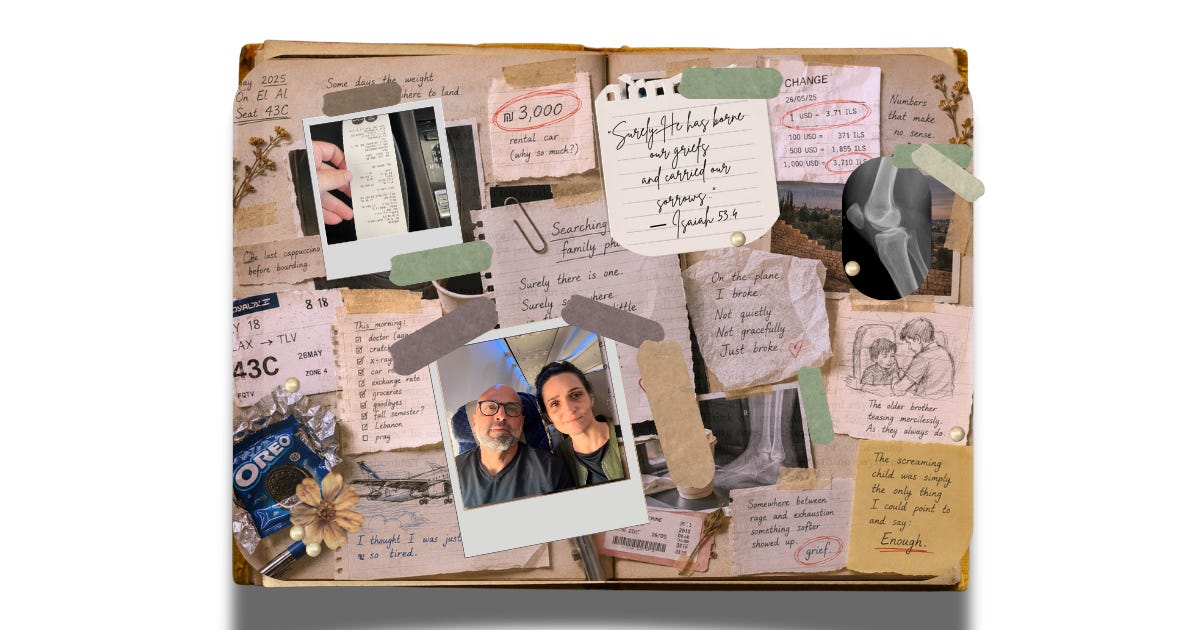
And if you hand us a piece of Fourth of July pie and ask how we’re doing, just know that somewhere over the Mediterranean, in seat 43C, is the answer.
Prayers for God’s continued blessings on your ministry. 💕🙏🙏🙏
Come visit us. I promise comfort, food, lots of love and plenty of prayer.